When Sharing Space Creates Unspoken Tensions

Today, I’m gonna share the unspoken tensions between workers that emerged in the home care agencies I investigated.
I think it's a really important story for designers.
When our team interviewed workers at two home care agencies, similar statements came up. They said there was nowhere to stay when they got back from their care visits because office-based staff made them feel unwelcome.
Let me explain how it happened.
There are two types of work at home care agencies: administration and home care visits. This is why there are office-based staff and field-based care workers. Field-based care workers need to rest when they're at the office so that they can continue to care for older adults.
But strangely enough, the space provided for them was a large, open shared office. And this space was connected to the office-based staff's workspace. At this point, let's take a look at the daily routines of care workers that we might not know much about.
After taking care of older adults, they come back to the office to take a short break, do some paperwork, or even wash up during the summer. This is because they often get soaked in sweat while caring for older adults. They also need to connect with other care workers. They talk, share their frustrations, and exchange tips and experiences.
But there wasn't really a proper space for any of these activities.
Here is what the care workers said.
"We often get together to have meetings and share things. When something good happens, we laugh and chat. But if our voices get a little louder, someone from the office comes over and tells us to be quiet..."
"I feel uncomfortable even when I'm just walking around. I feel like I have to be careful everywhere. So I end up staying in the training room... I wish I had my own place. We can't really do our work in the shared office. Even though there's a massage chair in the break room, it doesn't actually help us much."
"We work outside, but when we're here, we still need somewhere to stay, right? So we usually stay in the training room because it's at least a bit more enclosed. But when there's a training session, we have nowhere to go."
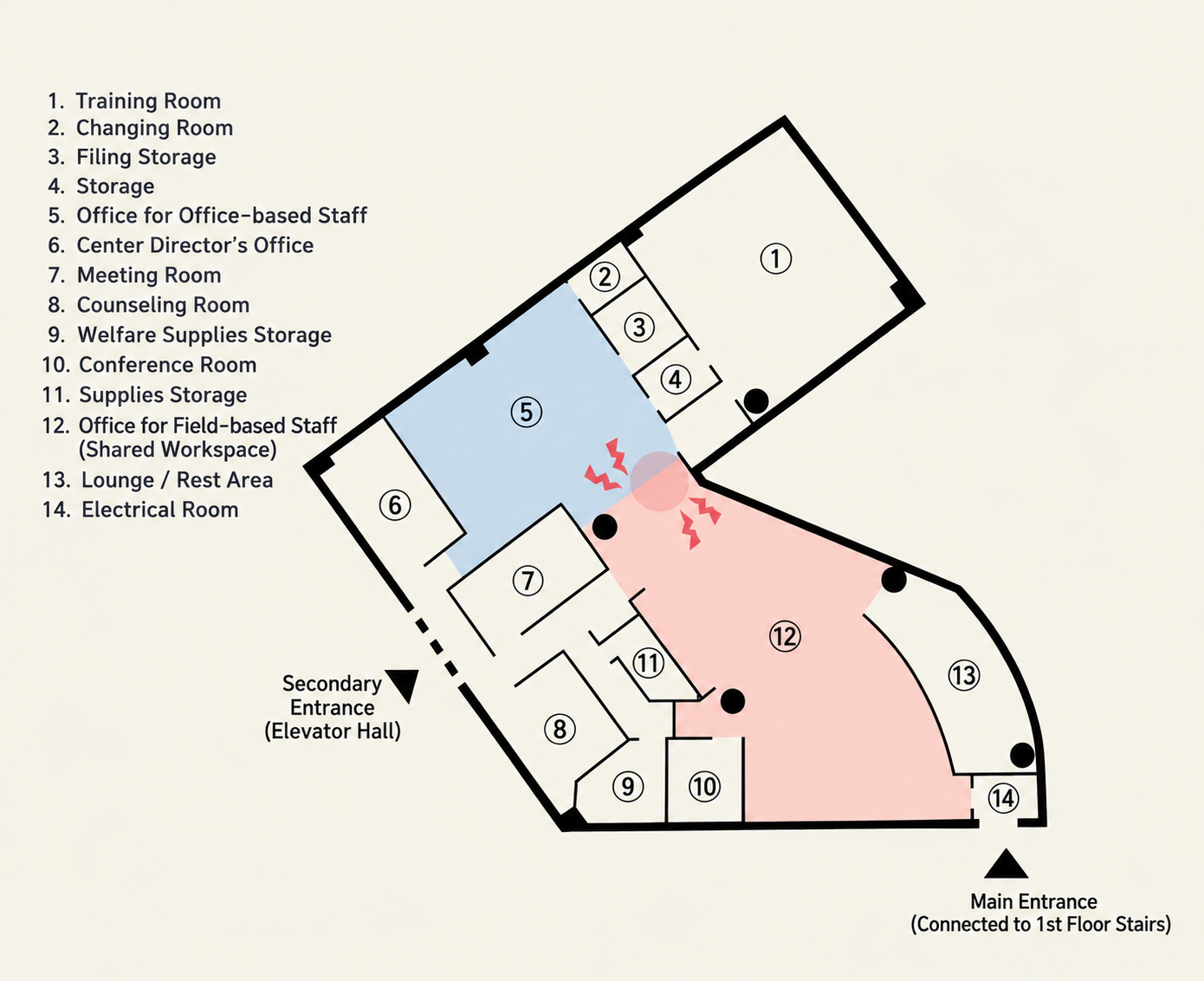
As you can see, the shared office was actually quite spacious. But the problem was that the space didn't reflect what care workers actually do during their waiting time, beyond their official duties. Resting well and communicating with colleagues are also part of care workers' jobs. So they need a proper space for these activities. At the same time, I can also understand the office-based staff. When they're trying to focus on administrative work, conversations between care workers can easily become noise.
Especially when two groups have different types of work, not having clear boundaries between them can create uncomfortable tensions. And when a subtle power game starts between the two groups, someone ends up being excluded. In the end, the shared office, which was supposed to be for everyone, became a space that didn't really work for either group.
But how could we have known about all these hidden issues without interviewing the workers?
What I find interesting about this case is that just because we design a space to be shared doesn't mean that different people's activities can naturally coexist. Sometimes, having proper boundaries is what actually makes sharing possible.
In the end, what matters is not how open or shared a space is, but understanding who uses it, when they use it, and what they need to do there.
Without this understanding, a shared space can become a place that is open to everyone but where no one actually feels comfortable staying.