[Local Community Hub] Musashino Place_ What happens when a public library stops being quiet?

Fieldwork to Musashino Place (武蔵野プレイス)
on 29 Aug 2026
Field Note
1. Who is here?
People of different ages use the space in different ways—from children and families to teenagers, adults, and civic groups.
2. What brings them here?
Easy access, a walkable neighbourhood, and plenty of affordable ways to spend time and enjoy different activities.
3. What actually happens?
Different ways of staying coexist: people read, study, talk, eat, meet, and work. On B2, teenagers can also hang out, play, and practise music or dance.
4. What enables these connections?
Visual and physical openness between spaces encourages co-presence and curiosity, while community programmes create opportunities for more active connections. Dedicated spaces for teenagers and families support interactions among them.
5. What can I learn? Compared to a conventional, highly regulated library, allowing flexible levels of conversation, eating, and social activity creates a much livelier public environment. Plus, rather than strictly matching one function to one space, Musashino Place shows how multiple activities can coexist under a shared theme within a single public facility.
First Impressions of Musashino Place
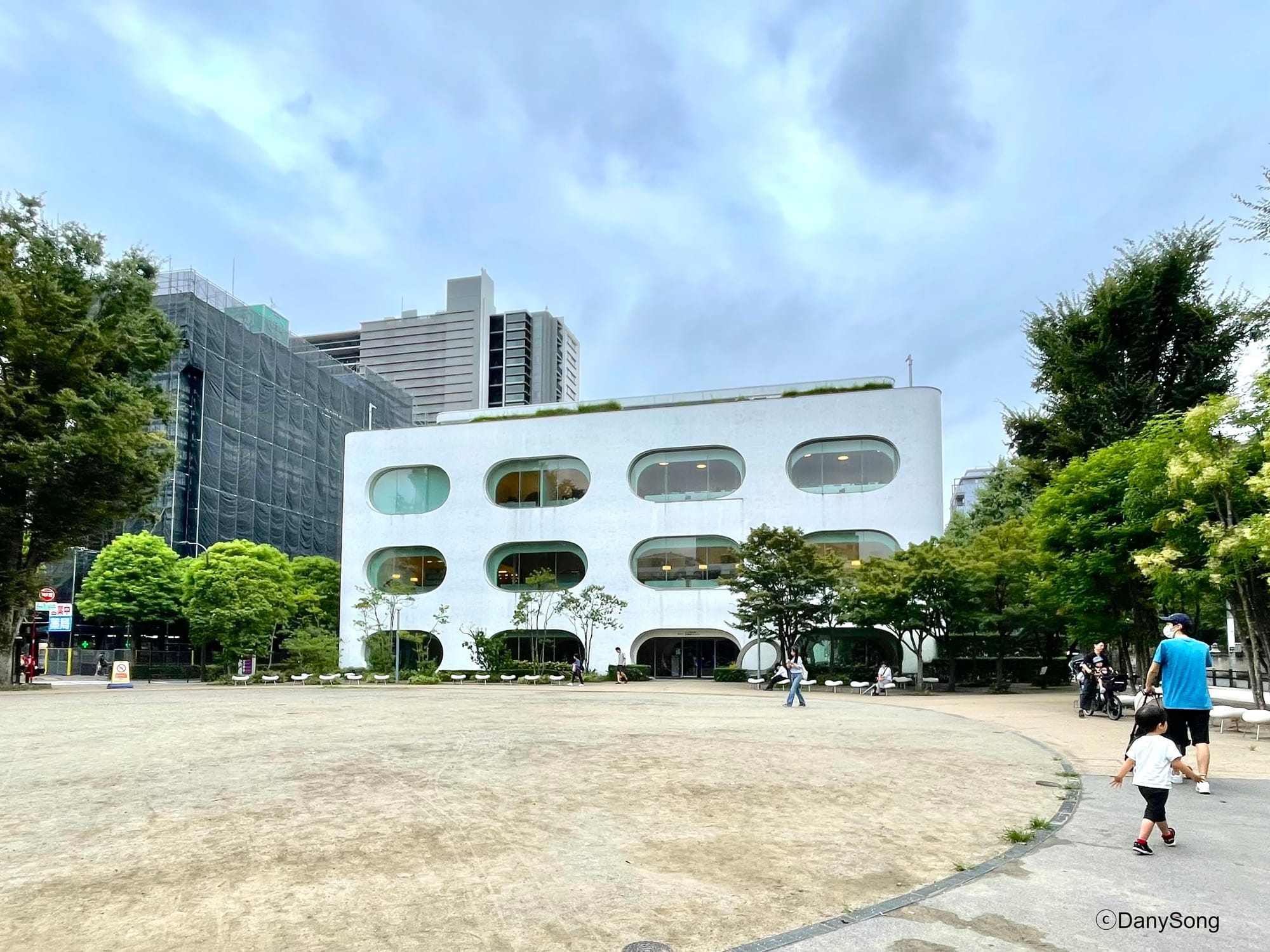
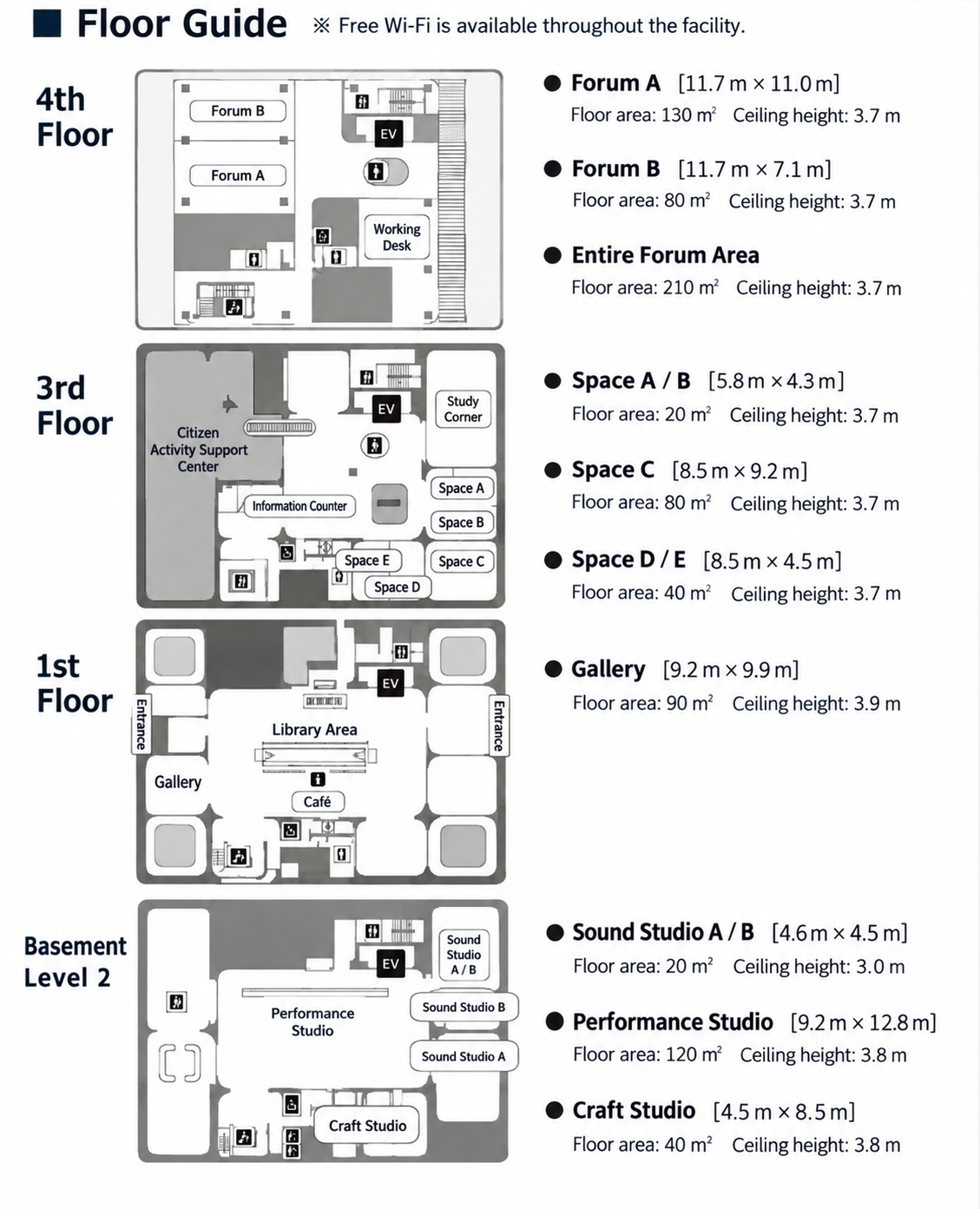
Musashino Place is a multi-purpose public facility operated by Musashino City, Tokyo. Officially, it is called the "Musashino Place for People, Town, and Information Creation." It is located in Kyonancho, Musashino City, just a one-minute walk from the south exit of Musashisakai Station.
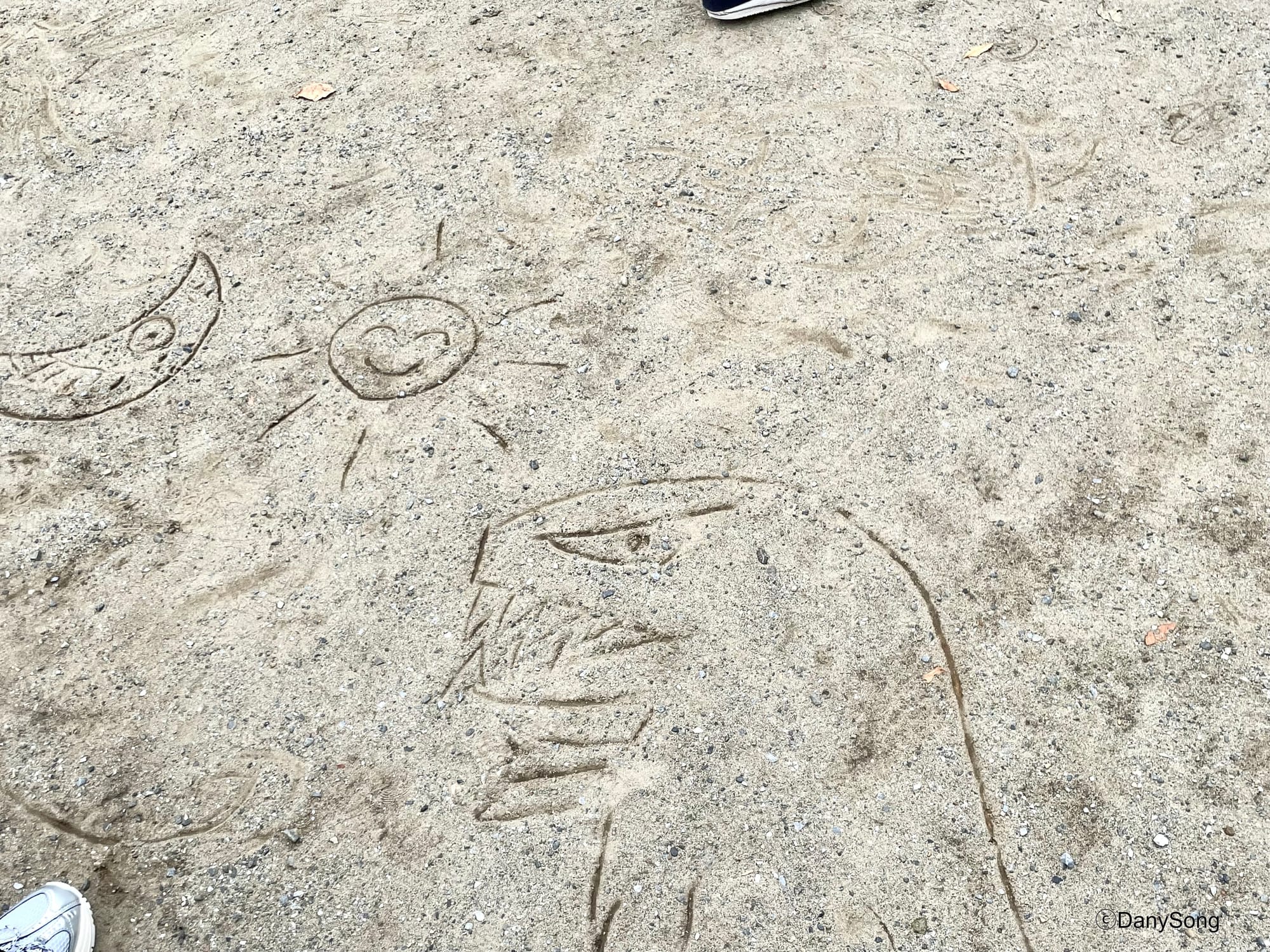
So it is very close to the shops built under the elevated railway tracks. In front of the building, there is a sandy yard that reminds me of an elementary school playground, equipped with chairs, benches, and tables. Here, children play, and people of all ages sit down to rest or have a light meal.
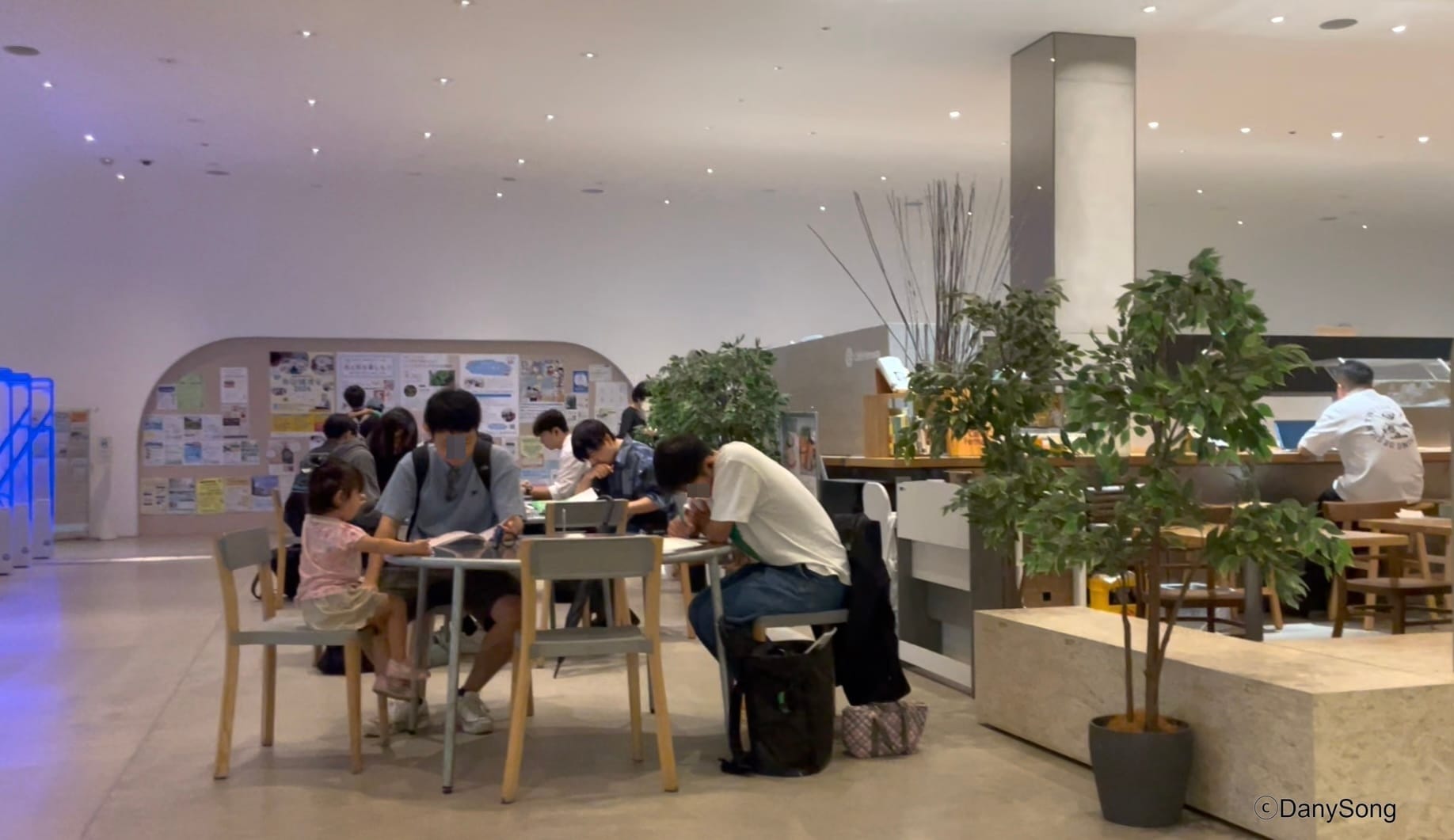
When you walk into the building, the first thing you see is a cafe right in the middle of the hall, which looks like a cozy brunch spot. For a second, it makes you wonder, "Wait, is this a library?" (in a positive way). The cafe also sells its own merchandise. While many public institutions waste their lobby space, this place fully utilizes the entire first floor.
Right next to the dining tables, there are people simply reading books. Surrounding this central area, you can find small bookshelves and an information desk. Just having this lively energy in the center makes the whole space feel truly alive.
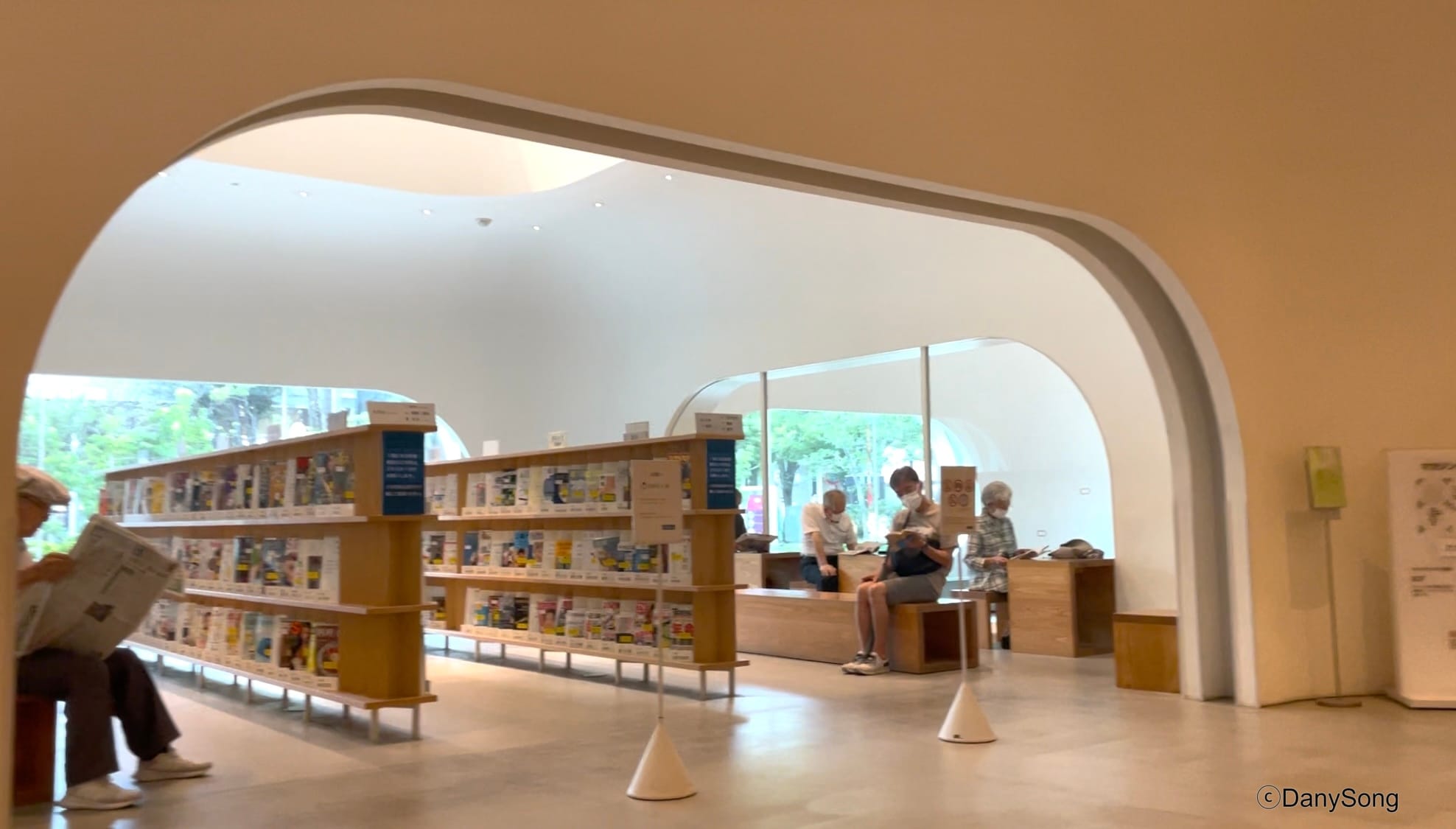
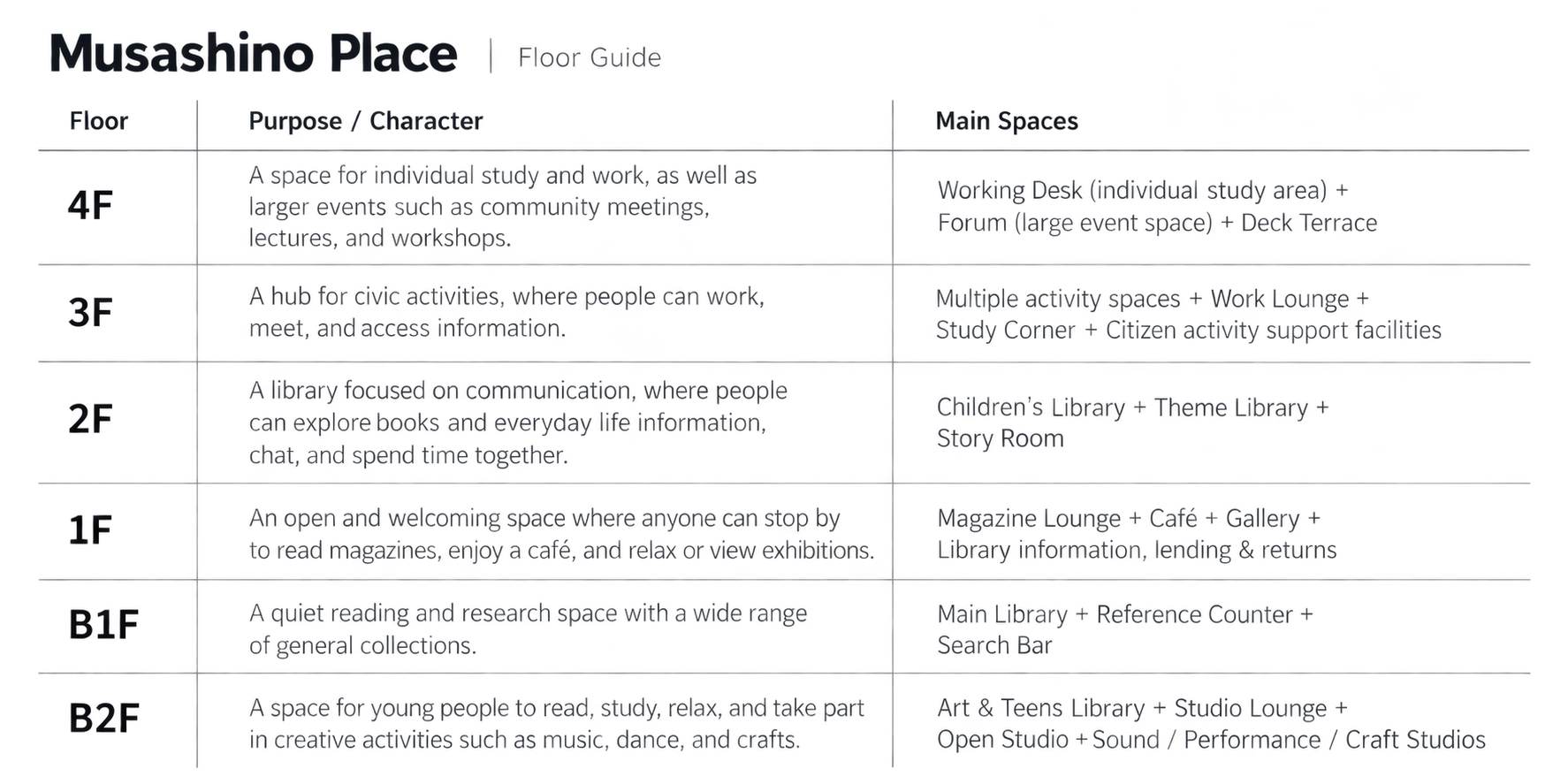
The 1st floor is designed as an open space for events such as exhibitions, lectures, and workshops. When I visited, no events were happening, but the space was still very active. This seemed to be because the cafe is located right in the middle, and it was almost lunchtime.
A Library for Focus, a Library for Communication
An interesting point about the spatial layout is that the library function is split across two floors, B1 and 2F, with the 1st floor in between. The official name for B1 is the "Main Library," defined as a quiet space for people who want to take their time choosing and enjoying books. 2F, on the other hand, is the "Communication Library," which focuses on daily life, family, and social connection.
First, the B1 level was extremely quiet. Looking at the entrances and wall finishes, they clearly put a lot of effort into soundproofing. It is optimized for reading, searching materials, and doing research.
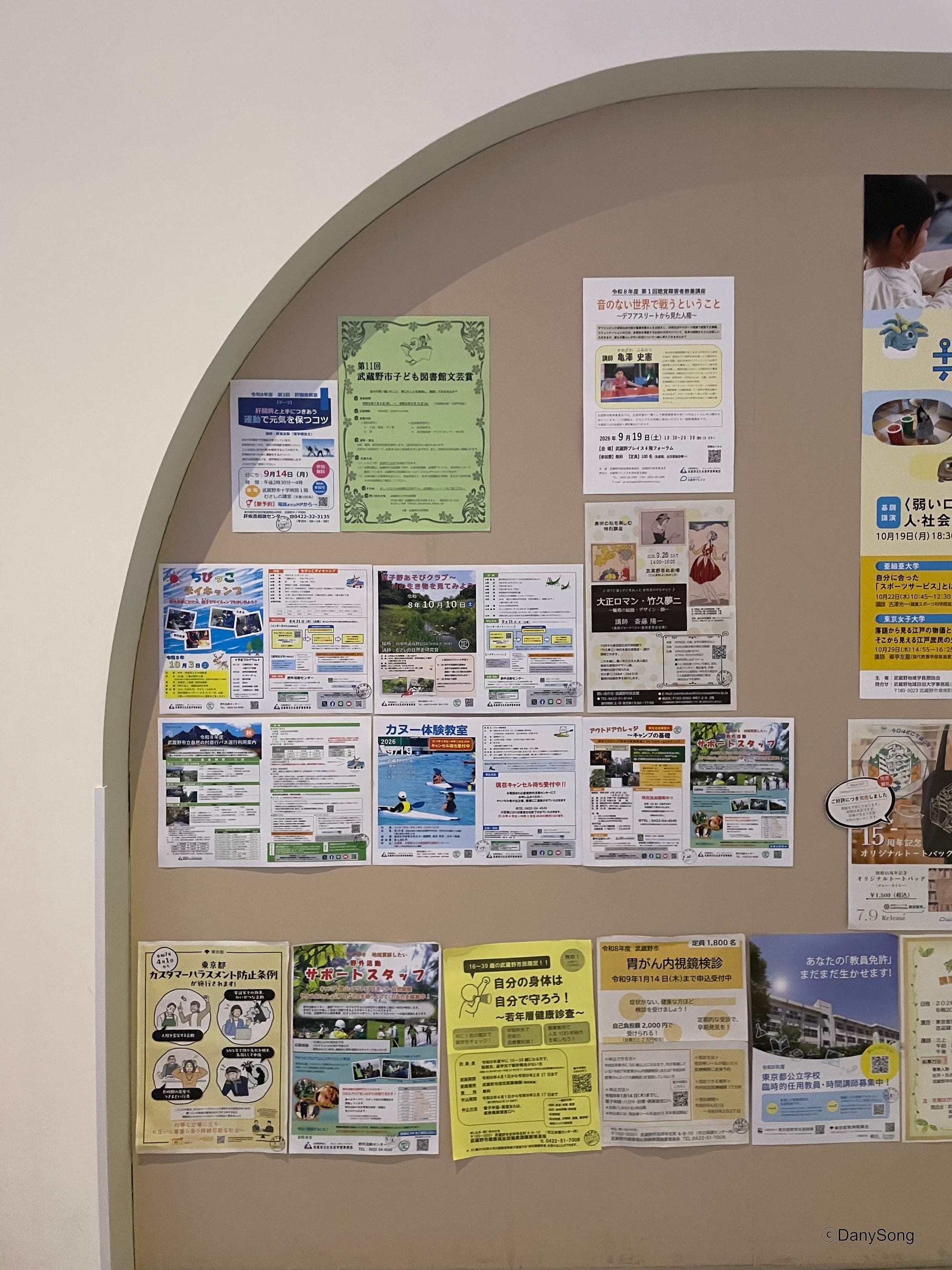
In contrast, the 2nd floor has a completely different vibe. It houses the Theme Library (covering daily life and hobbies like cooking, health, parenting, sports, and travel) alongside the Children's Library for toddlers and elementary students. The layout and furniture arrangements are much more flexible. There is a Story Room where parents and children can take off their shoes to read together, as well as a nursing room. On one side, various community programs for local residents are also being promoted.
Surprisingly, talking is allowed on this floor, even though it's a library!In fact, B1 was the only truly quiet space in Musashino Place. While visiting several libraries in Japan, I've noticed a growing trend of adopting rules that allow conversation. For instance, at the Yuinomori Arakawa Library, they have been conducting annual surveys about this rule since they introduced it. Over three years, more than 64% of users consistently expressed satisfaction[1].
Looking at libraries frequently cited as great examples of community hubs (like Oodi in Helsinki), it seems clear that libraries are actively expanding their role. They are moving beyond spaces just for reading and studying to become versatile community hubs. In these two Japanese libraries, applying conversation-friendly rules under the keyword "communication" seems to be a proactive practice to support this expansion.
A Study Room with a Twist: Study, Eat, Play
The space that impressed me the most was the B2 floor, designed specifically for youth. Rather than a collection of separate rooms, it felt like an open hall, and I think the activities happening in the center best represent what this space is all about. It is officially defined as "a space where youth can not only read and study, but also rest, hang out, and participate in activities like music, dance, and crafts."
The actual atmosphere was genuinely lively and bustling. Surrounding the hall are practice rooms where kids can rehearse dance routines or play musical instruments. In the central hall, low furniture serves as subtle partitions, with tables and chairs set up where kids can read, do homework, or even eat meals, and that was the most surprising part for me!
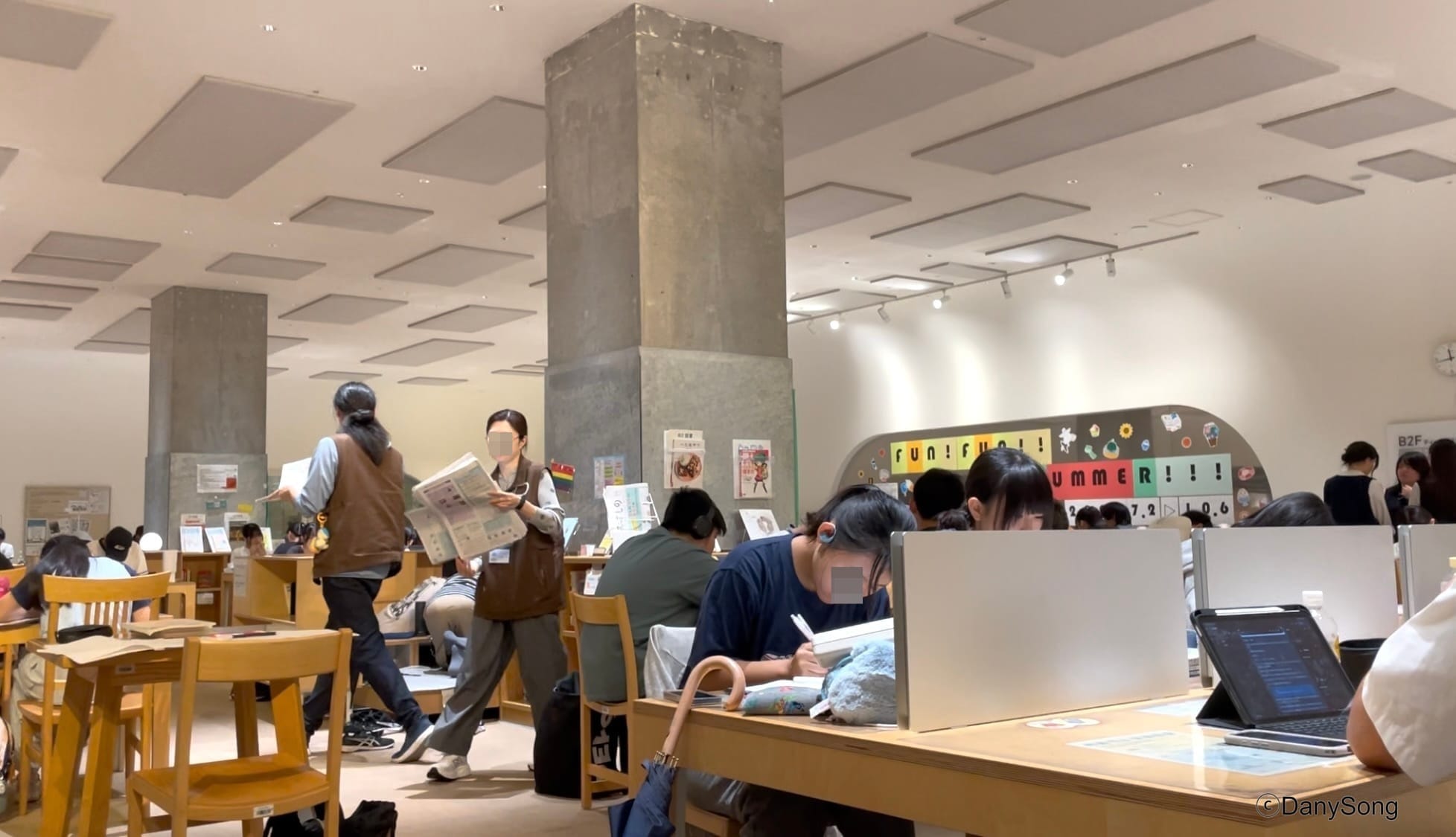
Seeing them eat inside was the biggest culture shock for me. I’m not sure if this is naturally accepted in Japanese culture, but in Korea, eating inside a library—especially outside designated dining areas—is implicitly taboo.
However, I believe that setting up an environment where people can talk and eat while going about their business naturally encourages staying longer and contributes to forming a "Third Place." (This person-behavior-place dynamic is something I personally find fascinating.) While it's hard to find studies addressing this exact setup, there is research showing that commensality (the act of eating together) promotes interaction and social bonds[2], and that repeated interactions mediated by food can help transform a space into a Third Place [3].
A Place for Civic Life
Lastly, the 3rd and 4th floors focus on citizen activities, lectures, and forums. In Korea, I rarely get to see civic activities happening in everyday public spaces like libraries, so it was fascinating to see what looked like actual local community groups having passionate discussions on the 3rd floor.
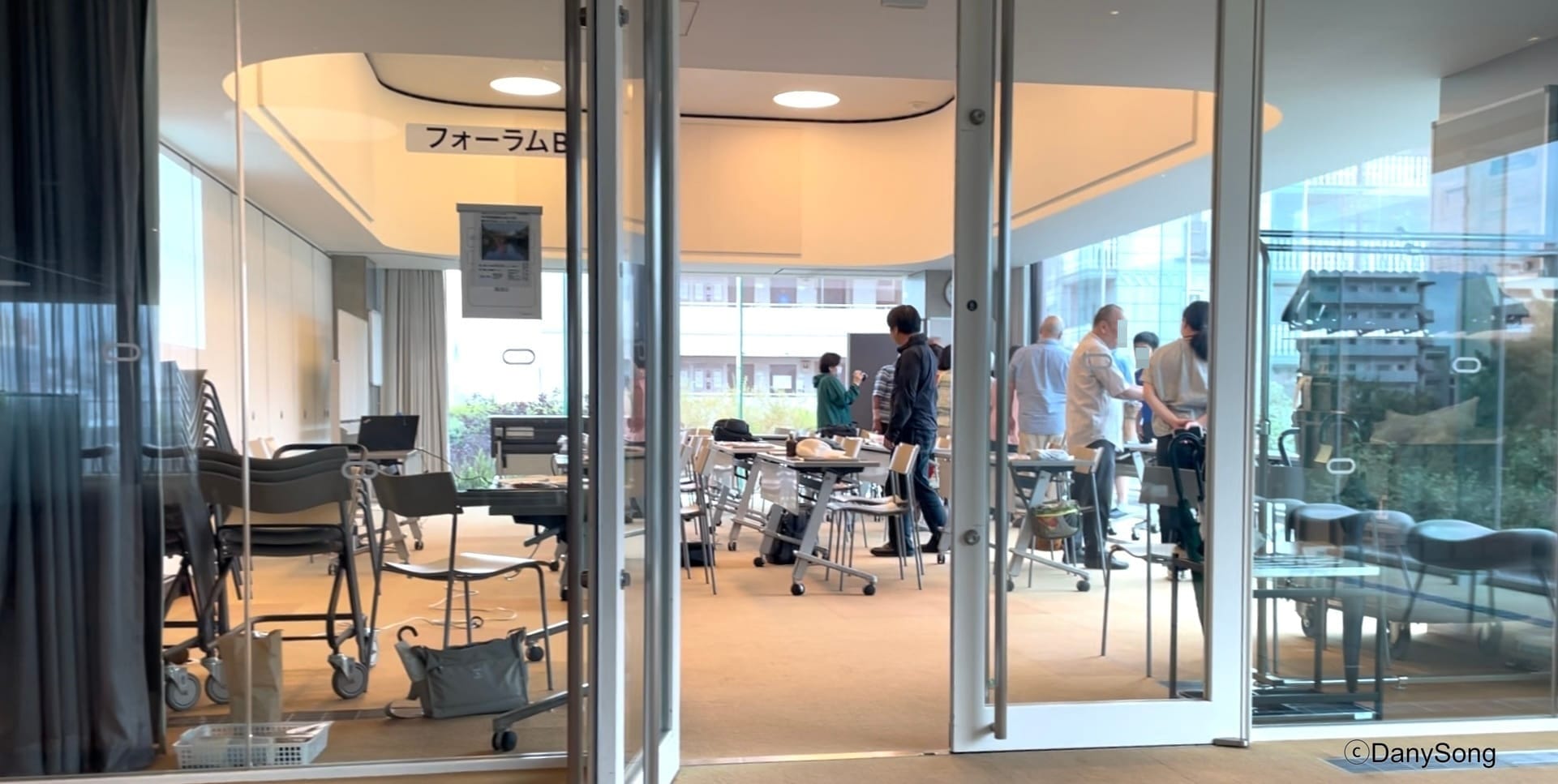
In Korea, you usually see these types of community activities happening in designated "Community Spaces" provided through government projects. While Korea certainly has spaces for civic activities, seeing Musashino Place made me think that creating purpose-built community spaces isn't the only answer—we can also actively make use of existing infrastructure.
Openness and visual connection
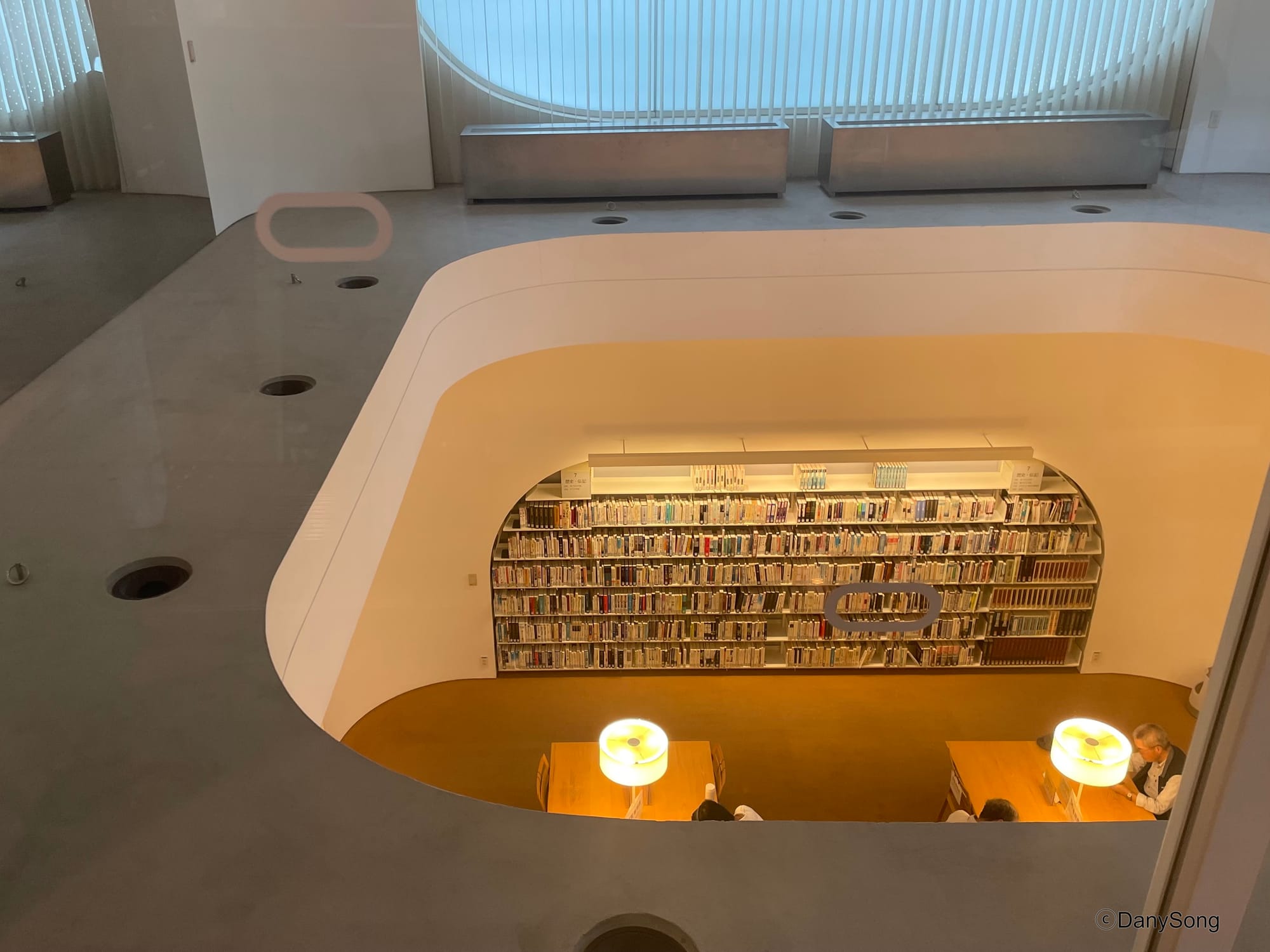
One spatial quality I noticed throughout Musashino Place was its visual and physical openness. Each floor was loosely divided into several spaces rather than completely enclosed, using large openings and transparent partitions. You could even see activities on other floors through glass walls.
While walking through the building, I found that this made me more aware of what was happening in nearby spaces. Being able to see other activities created a sense of sharing the same place and made me curious about what was happening around me.
This made me wonder whether simply accommodating diverse activities is enough to create a lively community space. How those activities are spatially connected—and whether people can see and sense each other—may matter as well.
In my next field note, I will look at a contrasting community facility(Tama Civic Activity and Exchange Center): one that also accommodates diverse programmes, but where spaces are more clearly separated into enclosed rooms.
Note
[1]Kyoto University of Arts Report (https://g.kyoto-art.ac.jp/reports/6513/), based on "Attachment 2: Arakawa City Survey Data" compiled by the author using original Arakawa City survey results.
[2]Giacoman, C. (2016). The dimensions and role of commensality: A theoretical model drawn from the significance of communal eating among adults in Santiago, Chile. Appetite, 107, 460–470.
[3]Gagné, N. O. (2011). Eating local in a U.S. city: Reconstructing “community”—a third place—in a global neoliberal economy. American Ethnologist, 38(2), 281–293.
For more information, visit the official Musashino Place website